
This is probably the single most common conversation happening in living rooms across Aurangabad district right now: should a JEE or NEET aspirant move to Patna, move to Kota, or prepare locally, and how much should that decision really be driven by a coaching brand's national reputation versus the actual day-to-day reality a specific student would experience there? It deserves an honest, specific answer, not a generic sales pitch — from us or from anyone else making the pitch.
Kota's advantage is genuinely real: unmatched density of experienced faculty, a culture where every single student around you is also preparing intensely, and study infrastructure (libraries, test series, peer groups) built specifically for this one purpose. For a student who is highly self-motivated, already strong in fundamentals, and can handle living independently at 16 or 17, Kota can accelerate an already-good trajectory.
Kota's disadvantages are just as real, and get discussed far less. The dropout and burnout rate among students who move to Kota underprepared or emotionally unready is well documented nationally. Large batches — sometimes 150 to 250 students — mean a student who needs individual attention can simply get lost. And the cost, including hostel, mess, and travel, typically runs several times higher than local coaching plus living at home.
Patna sits in between: closer to home than Kota, with several established institutes, but still requiring relocation for most Aurangabad district families, along with city-level hostel and living costs, and batch sizes that at the larger institutes can rival Kota's.
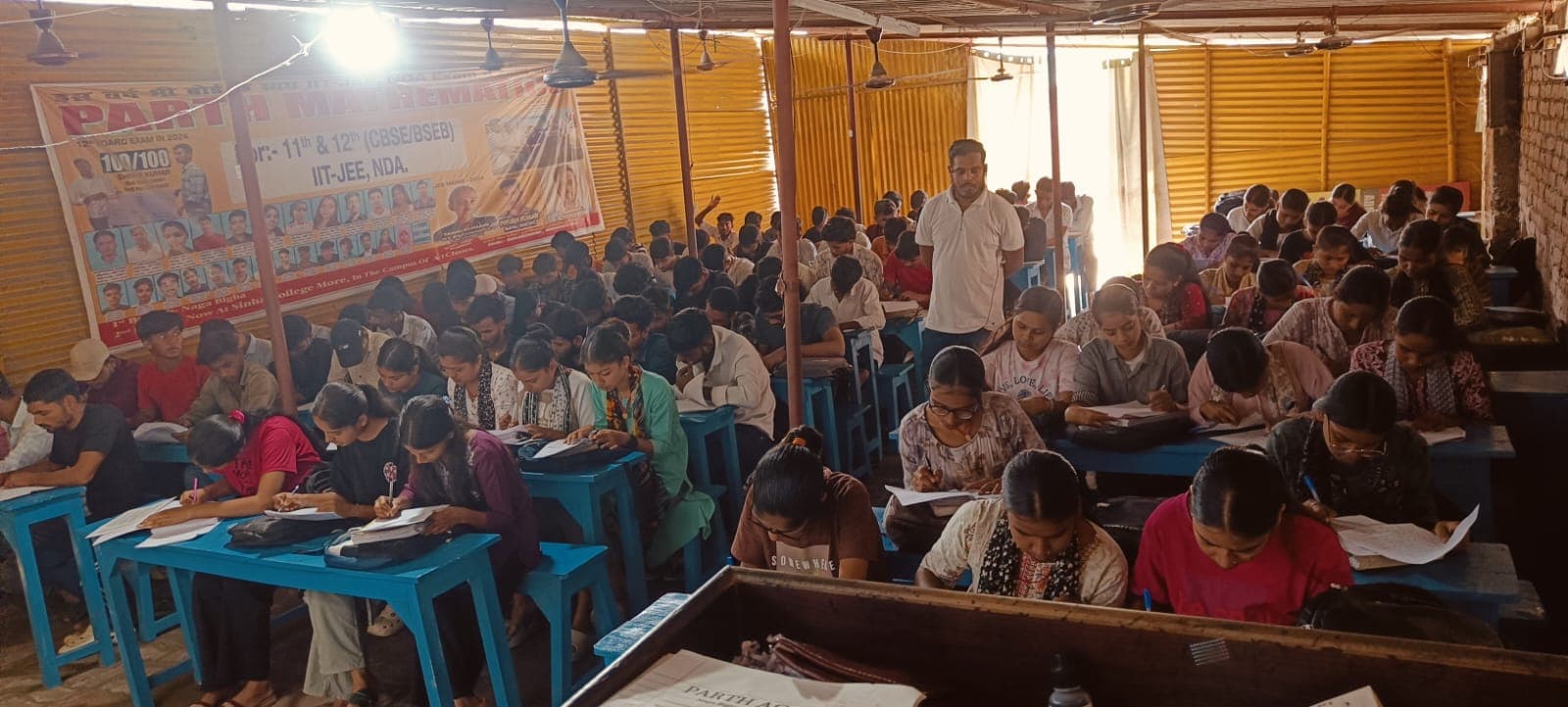
A well-run local coaching institute's real advantage isn't cost alone — it's the ability to combine small batch sizes with a student living at home, supported by family, sleeping in their own bed, eating home-cooked food, during what is already a high-stress two years. The academic ingredients that actually drive results — structured daily practice, weekly full-syllabus testing, faculty who track individual weak areas, six-day doubt resolution — don't require Kota's zip code to exist. They require an institute that's deliberately built its systems around them.
The honest answer to 'Patna, Kota, or local' depends on the specific student, not a blanket rule. A highly self-driven student who thrives on intense external competition and can handle independence may genuinely benefit from Kota. A student who needs individual tracking, family support, and a mentor who knows their name is often better served locally, regardless of what conventional wisdom says.
Let's put actual numbers next to this, even approximate ones. A typical two-year Kota residential program — tuition, hostel, mess, and incidental costs — commonly runs into several lakh rupees once everything is accounted for, before travel expenses for festivals and family visits. A local coaching program with a student living at home eliminates hostel and mess costs entirely, often bringing total two-year cost to a fraction of the Kota figure. That gap is not trivial for most Aurangabad district families, and it's money that can instead fund better study material, additional mentoring, or simply reduce financial pressure on the household during a stressful two years.
Peer environment cuts both ways, and it's worth thinking about honestly rather than assuming bigger is automatically better. Being surrounded by hundreds of intensely competitive peers in Kota can push a strong, resilient student to work harder. It can just as easily push an anxious or comparison-prone student toward constant self-doubt, since there is always, statistically, someone scoring higher on any given test in a batch that large. A smaller local batch narrows that comparison pool considerably, which for some students genuinely reduces destructive comparison anxiety and lets them focus on their own progress rather than a constant ranking against hundreds of others.
The support-system difference is harder to quantify but arguably matters more. A student struggling emotionally in Kota — homesick, anxious about falling behind a highly competitive peer group, or simply exhausted — often has to manage that alone, or lean on a warden or roommate who isn't equipped to help meaningfully. A student in Aurangabad district facing the identical struggle has parents at dinner, an existing friend circle, and a familiar environment to return to every evening. Academic performance and emotional stability are not separate things during JEE or NEET preparation — they directly affect each other, and one advantage of staying local is not having to fight both battles alone.
There's a middle path worth naming explicitly, since this comparison often gets framed as a binary choice when it doesn't have to be. Some Aurangabad district families choose a hybrid approach: a strong local coaching foundation through Class 11 and the first half of Class 12, followed by a short, focused test-series-only stint in a bigger city for the final few months before the actual exam, purely for exposure to a larger competitive pool and a wider variety of question styles. This isn't right for every family's budget or logistics, but it's a genuine third option beyond 'move for two full years' or 'stay entirely local,' and it's worth discussing openly with any institute you're evaluating rather than assuming the choice is all-or-nothing.
It's also worth asking what a 'dropout' actually looks like at each option, because the number rarely gets volunteered without being asked directly. In large, high-pressure environments — whether in Kota or at an oversized batch in Patna — a percentage of students each year switch to a less demanding stream, take a mental health break, or simply disengage quietly while remaining technically enrolled. That's not a reason to avoid ambitious environments altogether, but it is a reason to ask any institute you're considering, plainly: of the students who started this program two years ago, how many actually sat both exams at the end, and how many didn't. An institute — local or otherwise — that answers this without hesitation is one worth taking seriously.
What we'd push back on is the assumption — still common in Aurangabad district — that distance from home is itself a marker of seriousness or quality. It isn't. The markers of quality are batch size, testing rigor, and individual tracking, and those are worth demanding wherever you choose to prepare, including from us.