
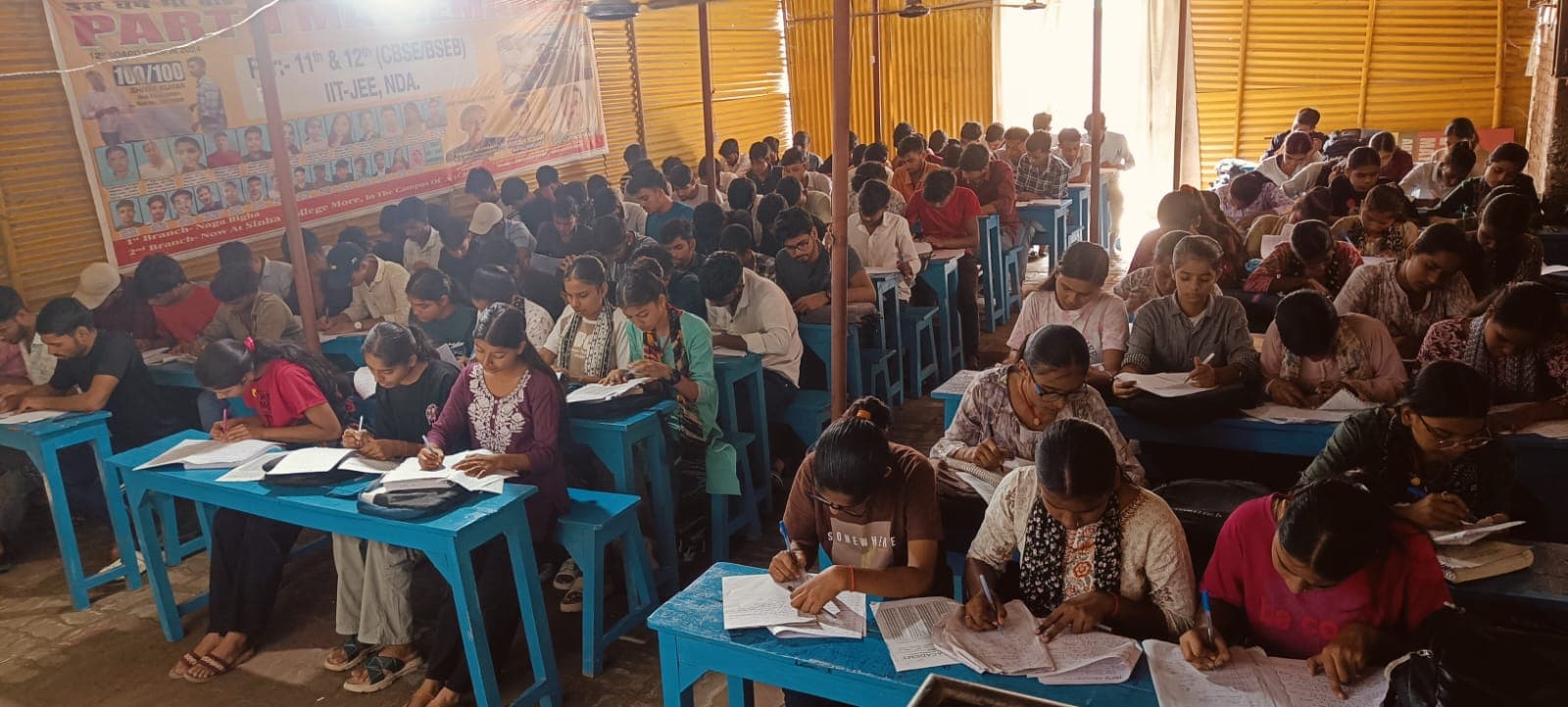
Bihar Board students preparing for NEET face a specific challenge that CBSE students often don't: the Bihar Board syllabus and exam pattern differ enough from NEET's NCERT-based structure that students frequently under-prepare NEET-specific topics while focused on board exam scoring patterns. Understanding exactly where NEET allocates its marks helps close that gap efficiently, especially in the final months before the exam.
Biology contributes 90 of NEET's 180 questions — fully half the exam — and within Biology, the marks aren't evenly spread. Genetics and Evolution alone typically carries the highest weightage, followed closely by Human Physiology, which contributes more marks than most entire Physics or Chemistry units combined. Reproduction and Ecology round out the highest-priority zone. A Bihar Board student with limited revision time should treat these four areas as non-negotiable, even before returning to chapters that feel more familiar from board exam preparation.
One detail that catches many Bihar Board students off guard: roughly 70 to 80 percent of NEET Biology questions draw from the Class 12 syllabus, with only 20 to 30 percent from Class 11. If your board exam preparation has naturally emphasized Class 12 content recently, that actually works in your favor for NEET — but don't let that create a blind spot around Class 11 fundamentals like cell biology and plant physiology, which NEET still tests directly.
Physics carries 45 questions, and here the pattern rewards depth over breadth. Mechanics-related topics — motion of systems and rigid bodies specifically — account for roughly a third of Physics marks on their own. Current Electricity, Semiconductor Electronics, and Thermodynamics each carry meaningful individual weightage as well. For a Bihar Board student managing limited time, mastering Mechanics thoroughly before spreading effort across every chapter equally is the higher-leverage strategy.
Chemistry tends to be the subject Bihar Board students most often shortchange in NEET prep, because board Chemistry exams reward a different kind of memorization than NEET's application-based questions. Organic Chemistry reaction mechanisms, in particular, need active problem-solving practice — reading through NCERT once is not sufficient preparation for how NEET actually tests these concepts.
The single highest-leverage habit for a Bihar Board student balancing both exams is weekly full-syllabus NEET-pattern testing, run in parallel with board exam preparation rather than after it. Waiting until board exams finish to begin serious NEET-pattern testing leaves too little runway to fix weak areas the test reveals. This is exactly why Parth Academy structures its NEET batches around weekly full-syllabus tests from day one, rather than treating testing as a final-months activity.
A practical way to apply this weighting is to build a rolling revision calendar rather than a single linear pass through the syllabus. In any given week, roughly half your revision time should go toward Biology's highest-weightage zones — Genetics and Evolution, Human Physiology, Reproduction, Ecology — even after you feel confident in them, because retention decays faster than confidence does. The remaining time should rotate through Mechanics-heavy Physics topics and Organic Chemistry problem sets, rather than being spread evenly across every chapter regardless of its actual exam weight. Students who revise by weightage consistently outscore students who revise by whichever chapter they studied most recently.
It's also worth being honest about diminishing returns. Once a high-weightage chapter is genuinely solid — meaning you can solve mixed, exam-pattern questions on it without hesitation, not just recognize the concept — additional hours there produce less benefit than the same hours spent on a medium-weightage chapter you're currently avoiding because it feels weaker. Most students unconsciously over-revise what they already know because it feels productive and safe, while genuinely weak chapters get pushed to 'later.' A structured weekly test is the most reliable way to catch this pattern before it costs real marks in the actual exam.
Time allocation across the full syllabus should roughly mirror question count, not personal comfort. If Biology is worth exactly half the exam, it deserves close to half of total study hours across a typical week — not the 30 percent it often gets when a student instinctively gravitates toward Physics numericals because they feel more like 'real problem-solving.' This sounds obvious written down, but in practice most students drift toward whichever subject feels most satisfying to study, which is rarely the subject carrying the most marks. Tracking actual hours spent per subject for even one week is often eye-opening for a Bihar Board student who assumed their time was already balanced.
Mock test analysis matters as much as taking the mock test itself, and this is the step most self-studying students skip entirely. After every full-syllabus test, the useful question isn't just 'what was my score' but 'which specific questions did I get wrong, and was it a knowledge gap, a silly calculation error, or a time-management issue where I simply ran out of minutes.' These three failure modes require completely different fixes — more revision, more careful practice, or better pacing — and lumping them together as 'I need to study more' wastes the single most valuable diagnostic tool available before the actual exam.
Diagram-based questions deserve a specific mention, since NEET Biology leans on labeled diagrams — the human heart, nephron structure, plant reproductive parts, the nitrogen cycle — more heavily than most Bihar Board exams do. A student who can describe a process in words but freezes when asked to identify a labeled part on a diagram is genuinely underprepared for a meaningful chunk of NEET Biology questions, even with strong conceptual understanding otherwise. Practicing directly from NCERT diagrams, not just NCERT text, closes a gap that pure textbook reading tends to leave open.
One more distinction worth internalizing: NEET rewards accuracy over attempted volume, since incorrect answers carry a negative marking penalty. A Bihar Board student used to board exams — where partial credit and generous attempt strategies are often rewarded — sometimes carries that same instinct into NEET-pattern testing, guessing on questions they're genuinely unsure about rather than leaving them blank. Reviewing which questions were guesses versus confident answers during mock test analysis, and tracking whether guessing is net-positive or net-negative for your specific accuracy level, is a small habit that meaningfully affects final scores.
If you're a Bihar Board student in Aurangabad district trying to build a NEET study plan that doesn't sacrifice board exam performance, this chapter-wise weighting is a reasonable place to start — but a personal mentor who can see your actual test results and adjust week to week will always beat a generic study plan, however well-researched.