
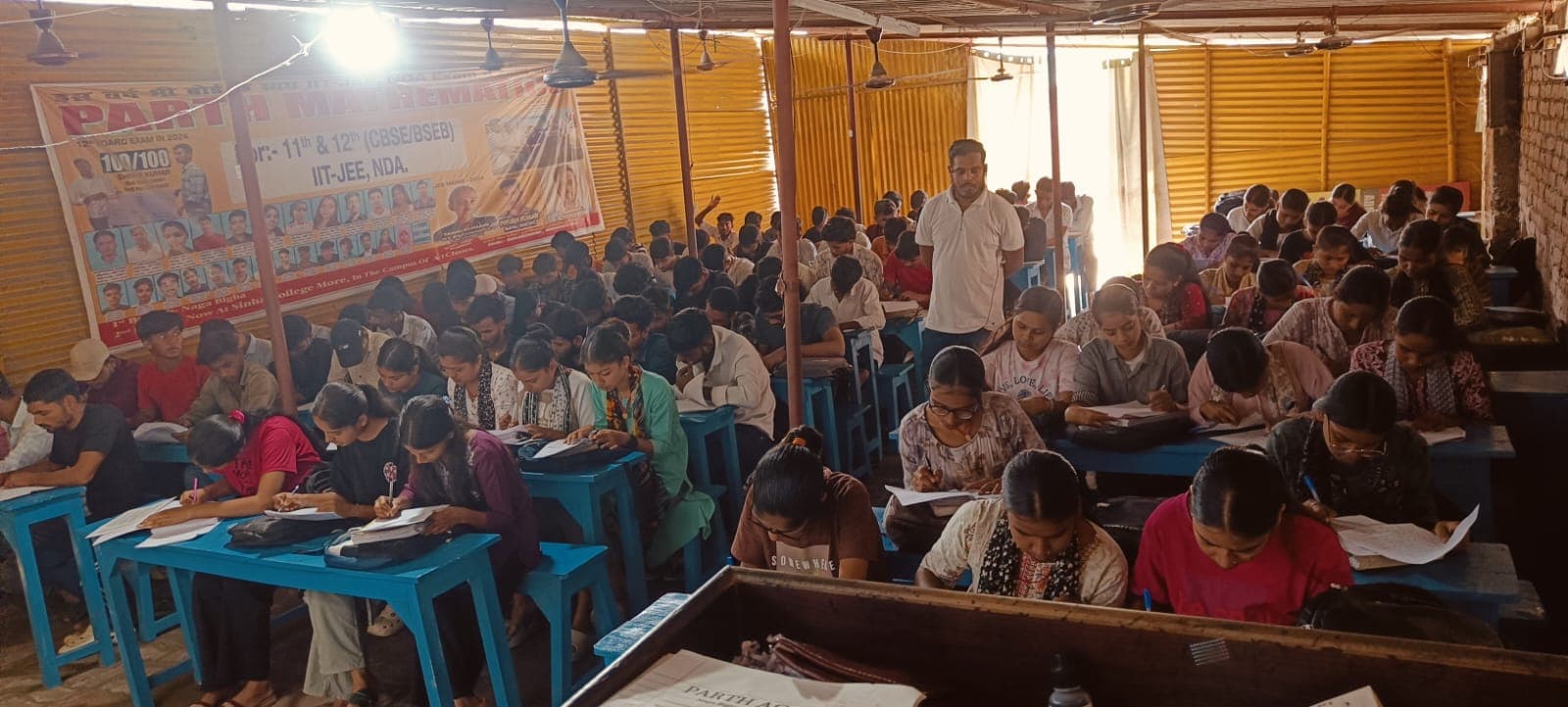
Most students preparing for JEE and NEET in Aurangabad district are enrolled in Bihar Board schools, while the majority of national coaching content — sample papers, reference books, even the pacing assumptions built into many online courses — is designed with CBSE students in mind. This isn't a minor difference; it changes what a Bihar Board student actually needs to focus on, and treating both groups identically in preparation strategy leaves real gaps unaddressed.
The most immediate practical difference is timing. Bihar Board exams have historically been scheduled earlier in the academic year than CBSE board exams, which is actually a structural advantage for JEE and NEET preparation that Aurangabad district students should be using more deliberately than most currently do. Finishing board exams earlier means more dedicated runway before JEE Main and NEET-UG for focused, exam-pattern practice — but only if that extra time is used for JEE/NEET-specific testing, not simply extended rest after a stressful board exam period.
Syllabus alignment is the second major difference, and it requires more active management from Bihar Board students than CBSE students typically need. NEET and JEE Main are both explicitly NCERT-based in their question design, and CBSE's curriculum tracks NCERT very closely by design. Bihar Board's syllabus, while broadly overlapping, has enough structural differences in sequencing and depth that a Bihar Board student cannot assume their board preparation alone covers NEET or JEE content adequately — NCERT itself needs to be studied directly and deliberately, alongside board textbooks, not as an afterthought.
Exam format is where the gap becomes most consequential. Bihar Board exams remain more descriptive and memorization-oriented in style compared to the objective, application-focused format of JEE and NEET. A Bihar Board student who scores well on board exams through strong written answers and recall has not necessarily built the specific skill of rapidly identifying the correct answer among four close options under strict time pressure — that is a distinct skill that needs its own dedicated practice, regardless of how strong the underlying subject knowledge is.
This exam-format gap is precisely why weekly, objective-format, full-syllabus mock testing matters more for Bihar Board students than it might for a CBSE student whose board exams already resemble the JEE/NEET format more closely. A Bihar Board student who only starts practicing objective-format questions in the final months before JEE or NEET is building an unfamiliar skill under the worst possible time pressure — that practice needs to start well over a year in advance, run in parallel with board preparation.
English-medium exposure is a related, less-discussed factor for many Bihar Board students in Aurangabad district, particularly those from Hindi-medium school backgrounds. JEE and NEET question papers are available in English and Hindi, but a large share of reference material, mock tests, and eventually medical or engineering coursework itself is in English. Students who aren't already comfortable reading technical content in English benefit from deliberately building that comfort well before the exam itself, rather than encountering it for the first time under pressure.
Bihar Board students sometimes carry an unearned assumption that their board curriculum's academic rigor is somehow lower than CBSE's, and this can quietly undermine confidence in a way that has nothing to do with actual ability. This isn't accurate in any way that matters for JEE/NEET preparation — the gap between the two boards is one of exam format and syllabus alignment, not one of underlying academic difficulty or student capability.
For Bihar Board students specifically, we recommend treating NCERT as the primary preparation text from the start of Class 11, rather than treating board textbooks and NCERT as two separate, sequential tracks to get through. Studying concepts directly from NCERT the first time, rather than relearning them from NCERT later after already learning them from a Bihar Board textbook, saves significant duplicated effort over two years.
Bihar Board's own recent reforms and the state's free JEE/NEET coaching scheme have narrowed some of this gap, and it's worth Aurangabad district families staying aware of these changes rather than assuming the board's structure is static. That said, structural exam-format differences between Bihar Board and CBSE are unlikely to disappear entirely, which means the preparation adjustments described here remain relevant regardless of ongoing curriculum reforms.
Mathematics deserves a specific mention alongside Physics, Chemistry, and Biology, since JEE Main's Math section is often where the CBSE-versus-Bihar-Board gap shows up most sharply in practice. CBSE's Class 11-12 Math curriculum tracks NCERT extremely closely in both content and problem style, while Bihar Board Math, though covering similar core topics, presents them with different problem conventions. A Bihar Board student aiming for JEE should treat NCERT Math exemplar problems as essential practice material, not optional supplementary reading.
A coaching program that's specifically designed with Bihar Board students' actual starting point in mind — rather than one built primarily for CBSE students and loosely adapted — will structure its syllabus pacing, testing schedule, and English-language support differently from the start. This is worth asking about directly when evaluating any coaching institute in Aurangabad district: has this program been built for Bihar Board students, or simply offered to them.
Teacher familiarity with both systems matters more than families typically consider when choosing a coaching institute. A faculty member who has only ever taught CBSE students may unconsciously pace lessons and reference points around assumptions that don't hold for a Bihar Board student's actual background. Ask directly whether an institute's faculty have specific experience teaching Bihar Board students for JEE and NEET, rather than assuming teaching competence transfers identically across board backgrounds, since the pacing and gap-filling a Bihar Board classroom needs is genuinely different from what a CBSE-only classroom requires.
If you're a Bihar Board student in Aurangabad district building a JEE or NEET preparation strategy, the two adjustments worth making immediately are starting NCERT-direct study from Class 11 rather than deferring it, and beginning objective-format, timed testing well before your board exams are finished rather than only after them, since both changes compound significantly in your favor the earlier they start.